The Spanish Era, 1519 to 1836
- Early Spanish Exploration
- French Exploration
- Conflicts on the Mission Frontier
- Mexican Independence and American Immigration
Early Spanish Exploration
The first Europeans to explore Texas were Spaniards. In 1519, Alonzo Alvarez
de Pineda led a naval expedition that mapped the Gulf Coast from Florida to Vera
Cruz. Among other adventures, the expedition landed at the mouth of a river that
they named Rio de las Palmas, which is almost certainly today�s Rio Grande.
After spending forty days exploring inland, they sailed on to Vera Cruz in
present Mexico.
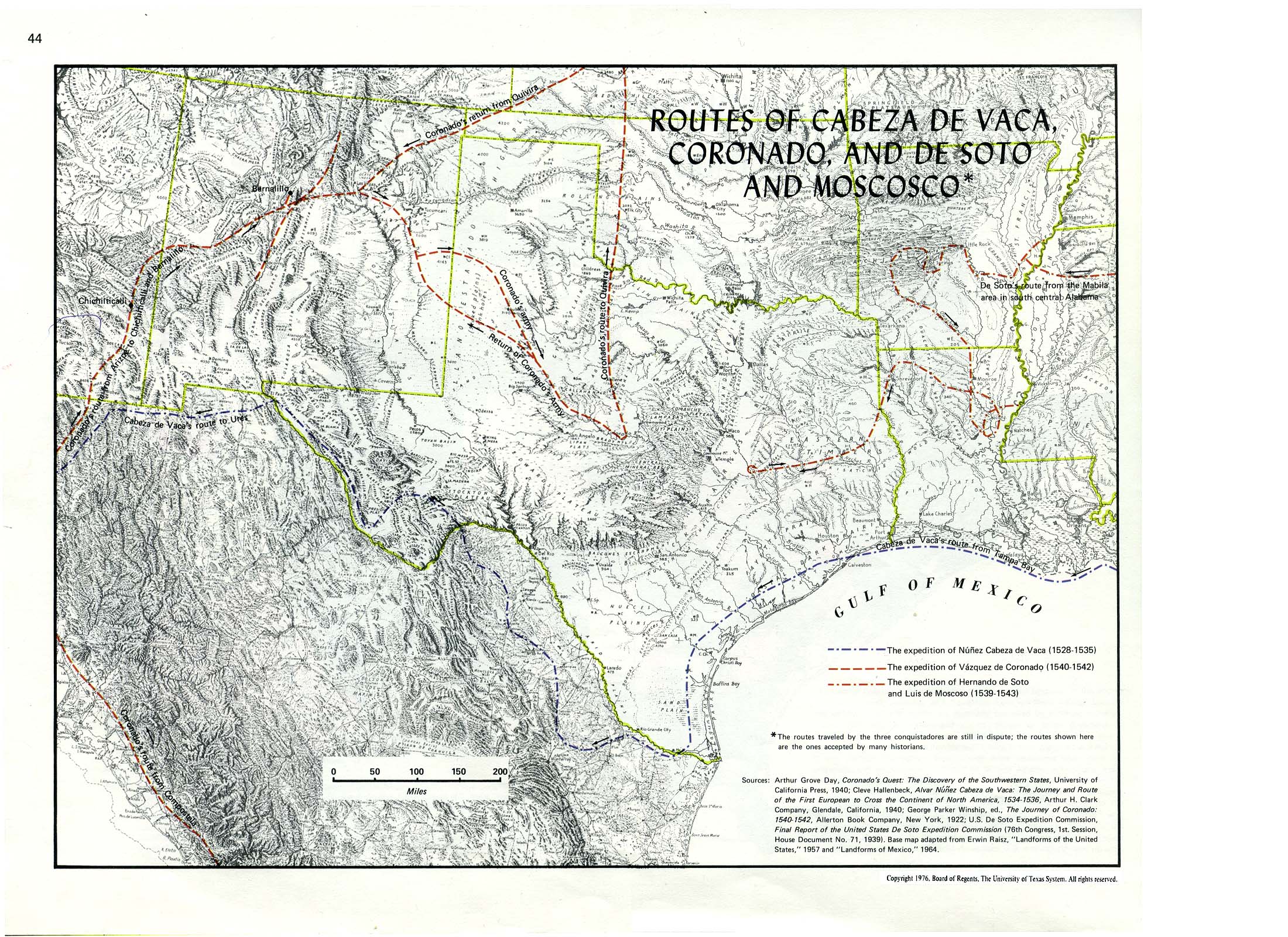
In 1528, Paniflo de Narvaez led a naval expedition that took six hundred
colonists to Florida where the entire group wound up stranded. Trying to get to
Mexico, the group made several crude boats that sailed down the Gulf Coast. The
boats were shipwrecked on the Texas coast near the mouth of the Brazos River.
After a terrible winter, only fifteen Spaniards remained alive. Alvar Nunez
Cabeza de Vaca and the Spanish Moor Estevanico (or "Little Stephen")
were among those survivors. Coastal Indians enslaved the group, but de Vaca and
Estevanico, along with two others, escaped in 1534. After wandering through
southeastern and southern Texas, they reached Mexico in 1536.
| Indians that de Vaca contacted during the trip told him stories of great cities full
of silver and gold that existed to the north. After de Vaca told such tales to
Spanish authorities, they sent an expedition guided by Estevanico and supervised
by Friar Marcos de Niza to find the rich cities. After de Niza falsely
claimed to have seen the golden cities, authorities in Mexico sent a larger
expedition commanded by Francisco Vasquez de Coronado
northward in 1540 in search of these cities called Quivira. |
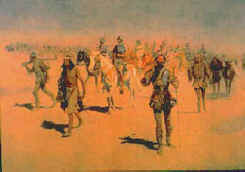
Coronado expedition in search of
Quivira, Painting by Frederic Remington |
After finding
Zuni pueblo people in New Mexico, Coronado's expedition turned east into Texas and
wandered over the
Llano Estacado, before striking the Salt
Fork of the Brazos River. Then, the men turned south to reach the Colorado River.
Turning north, the
expedition eventually found a poor Wichita
Indians village in southern Kansas. Because
he discovered no gold or silver, Coronado considered his expedition a failure and
returned to Mexico.
| At about the same time of Coronado�s expedition, another Spanish expedition
under Hernando
De Soto left Cuba and made a landing in Florida. After
plundering their way across today�s Deep South, the men reached the Mississippi River
where De Soto died of fever. His deputy Luis de Moscoso took control and in 1542
tried to lead the men overland to Mexico. The group traveled as far south and
west as the Trinity River (they may have reached the Brazos) before turning back
to the Mississippi. After building crude boats, the surviving men finally
reached Mexico by sea. |
Click on the map for a
larger image.
Map of de Vaca, Coronado and DeSoto expeditions in Texas
(Courtesy of
University of Texas Perry-Casta�eda Library Map Collection.) |
Because both the Coronado and De Soto expeditions found no riches, they were
regarded as failures. Such failures caused Spain to lose interest in Texas and
other lands to the north. However, many years later, in 1682, the Spaniards did
establish a mission at Ysleta, near present-day El Paso.
There, missionaries tried to Christianize Indians in the area.

Additional Resources
Study Guide Questions:
- Who commanded the first Spanish expedition to reach Texas and when did it occur?(7.1:C)
- Who were Alvar Nunez Cabza de Vaca and Estevanico?
What did they tell Spanish authorities about Texas?(7.2:B)
- Who were Coronado and De Soto? Why did they come to
Texas?(7.2:B)
- Why did Spain lose interest in exploring Texas?
Back to Top |