| Key to Texas |
|
|
   |
|
The Civil War and After: 1861-1875Causes of the WarEarly in the colonial era, the United States began evolving into separate regions of the North and South. Life in the Southern states of the United States developed along very different lines than those in the North. In the North, business became more industrialized, making the use of slave labor obsolete. Factory owners could hire wage laborers more cheaply than they could maintain slave gangs. Things were much different in the South. Slave labor was still in large demand in the southern states, as many industries were directly related to cotton production. Though most people lived on small farms in the South, owners of the largest plantations wielded great political power over the region. By 1804 all the Northern states had outlawed slavery, and a few extremists, called abolitionists, called for the immediate emancipation of all slaves in the United States, without compensation to the current owners. As more people migrated westward, the slavery issue became even more controversial. Northerners wanted to prevent slavery from spreading to the Western territories, and Southerners believed that they maintained the right to carry their slaves into the West.
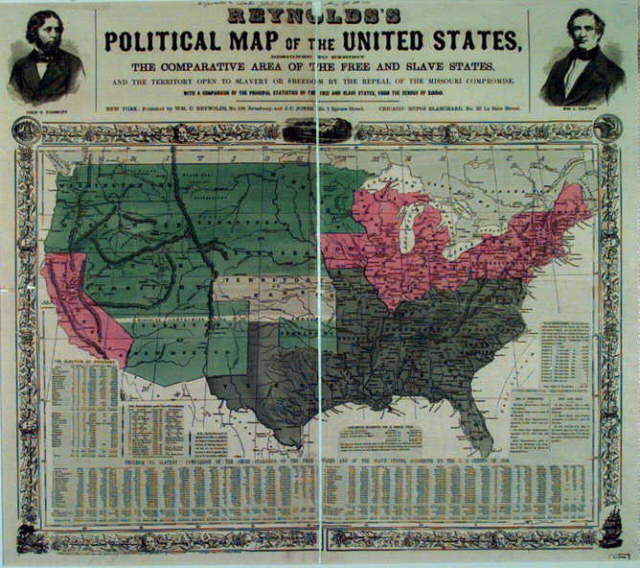
Reynolds Political Map of the United States,
designed to exhibit the comparative area of the free and slave states
New York and Chicago, 1856 Motivated by the slavery issue and other political debates of the 1840s, Northerners and Southerners strongly disagreed with one another over the definition of "states� rights." The "states� rights" debate centered on the issue of how much control and power resided with the states as compared with the authority of the United States government. Many Southerners strongly believed that the federal government was created by the states; therefore, the states were more powerful than the federal government. Based on their beliefs, Southerners argued that the people of the states could themselves choose which federal laws to obey. Southerners feared that the national government would take away their right to own slaves. Conversely, Northerners felt strongly that the federal government maintained power over the states, especially regarding the slavery issue. Given that many of them had migrated from the South, many Texans felt strongly about keeping their slaves. They did not plan on giving up their slaves without a fight. Though a majority of the Texans did not own slaves, they sided with the slave owners because they believed that the national government did not maintain the constitutional right to outlaw slavery in their state. A minority of Texans felt that slavery was morally wrong. They sided with Northern abolitionists, calling for the end of slavery. During the 1850s, relations between the North and South continued to worsen. Following Abraham Lincoln�s presidential victory in 1860, Southern states began to secede from the Union. Southerners viewed Lincoln as an abolitionist and feared that he would try to end slavery in the South. During the period of secession, Sam Houston was governor of Texas. He strongly urged Texas to remain in the Union, warning that secession would only lead to a bloody war that the South could not win. Despite Houston�s warnings, political leaders in Texas called a convention in early 1861 to discuss the matter. At the convention, a vote was taken and an Ordinance of Secession was passed on February 2, 1861. Only eight of the 166 delegates at the convention voted against secession. Before Texas officially seceded from the Union, however, the people were given the opportunity to vote on the issue in a special referendum. The referendum vote, held on February 23, 1861, overwhelmingly supported leaving the Union.
Additional Resources
Study Guide Questions
|
|